Atacama Desert, Chile
A high‑altitude desert where salt valleys, steaming geysers, and soft Andean light create one of Chile's most atmospheric otherworldly landscapes.
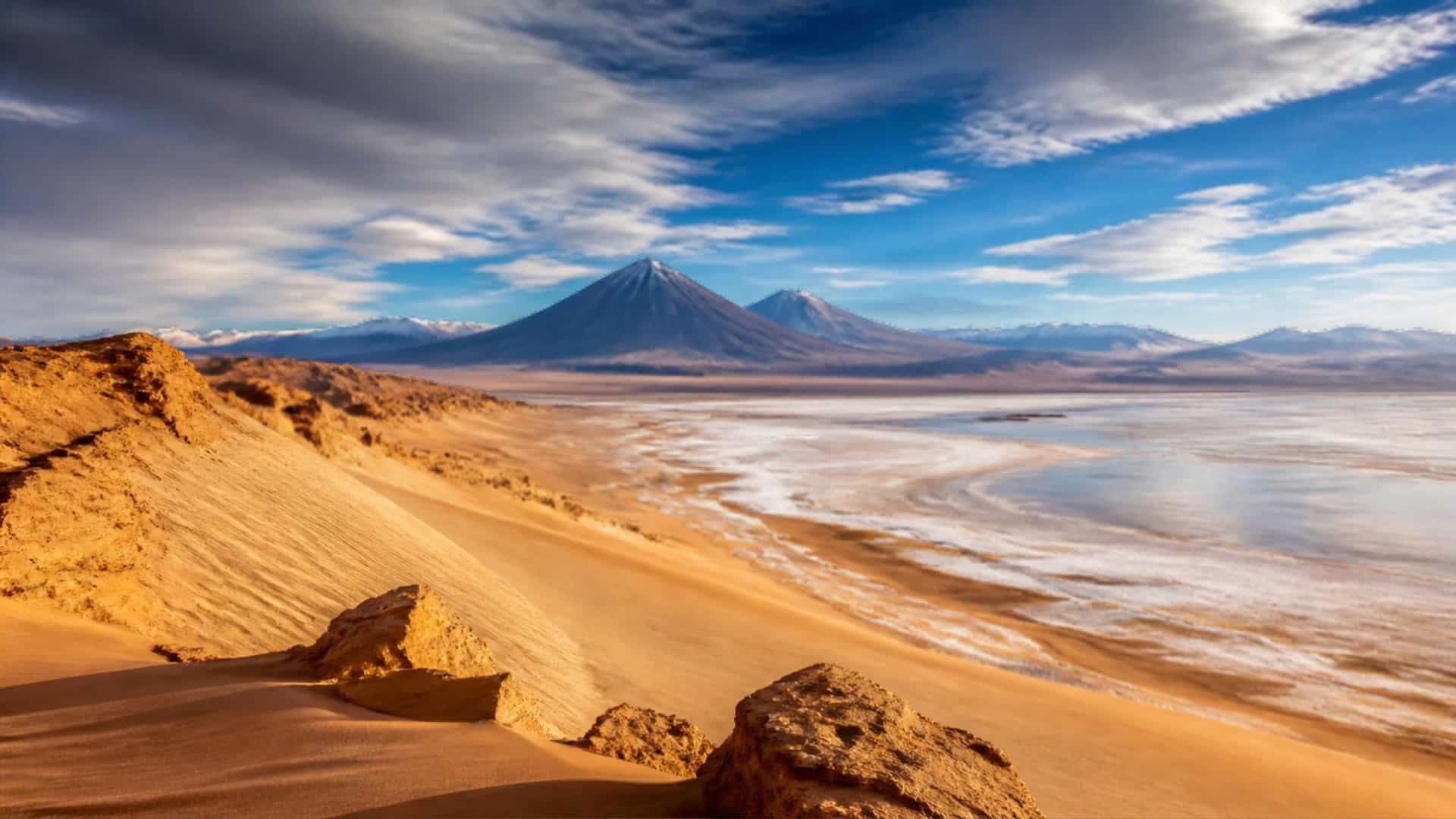
A high‑altitude desert where salt valleys, steaming geysers, and soft Andean light create one of Chile's most atmospheric otherworldly landscapes.
4.9/5 ⭐Google 660+ Reviews | A+ Better Business Bureau

Overview
The Atacama spreads across northern Chile's high plateau, shaped by salt flats, volcanic peaks, and valleys carved into forms that feel almost lunar. San Pedro de Atacama, a low adobe oasis town, anchors the region—its dusty streets and flat-roofed buildings giving way in every direction to dunes, lagoons, and geyser fields. Movement here follows the sun and the altitude: pre-dawn departures climb toward steaming geysers, midday brings salt-flat glare, and evenings settle over Moon Valley in deepening color.
What defines the Atacama is its balance of extreme aridity and vivid life. You move from pale salt crusts to deep-blue highland lagoons, from freezing dawn air at 4,300 meters to warm afternoon desert glow, and from silent dune fields to flamingo-dotted wetlands. The terrain is vast and mineral, the atmosphere rarefied, and the scenery relentlessly dramatic. It's a destination where emptiness, color, and altitude combine into something unforgettable.
Valle de la Luna at Sunset in Atacama Desert, Chile is worth visiting. Salt ridges, dunes, and rock formations glowing in evening color.
Tip: Arrive an hour before sunset for the full color shift.
El Tatio Geysers at Dawn in Atacama Desert, Chile is worth visiting. Steam columns rise over the world's highest geyser field.
Tip: Dress for freezing temperatures before sunrise.
Salar de Atacama & Chaxa Lagoon in Atacama Desert, Chile is worth visiting. Chile's largest salt flat is with flamingo colonies and glassy lagoons.
Tip: Afternoon light is kindest for flamingo photography.
Lagunas Miscanti & Miñiques in Atacama Desert, Chile is worth visiting. Deep-blue highland lakes beneath perfect volcanic cones await you.
Tip: Mornings bring the stillest water and clearest reflections.
Laguna Cejar Float in Atacama Desert, Chile is worth visiting. A hypersaline lagoon where you float effortlessly, like the Dead Sea.
Tip: Bring a towel, and there are no facilities at the shore.
Atacama Stargazing Tour in Atacama Desert, Chile is worth visiting. Some of the clearest night skies on Earth through guided telescopes.
Tip: Book around the new moon for the darkest skies.
Our expert consultants and customer service teams are standing by to help with all of your cruising needs.
[Our Cruise Expert] and his team were absolutely amazing to work with! Our original trip was unexpectedly canceled by the airline, so we decided at the last minute to go on a cruis...
Julia K.
I've booked several cruises with [Our Cruise Expert] in the past 15 years and continue to book with her for my family of five. We just returned from a Western Caribbean cruise on...
John C.
Friendly and professional attention by my senior cruise consultant. Perfect assistance. Thank you
Jose M.
I was having some trouble finding the right cruise for the right price as a single traveler, but thanks to [our Cruise Expert] I was able to find it with Cruise Web. Thank you very...
Camille G.
We have worked with [our Cruise Expert] several times and she makes it so easy and a pleasure to work with. She is very knowledgeable.
Linda F.
[Our Cruise Expert] was informative and very pleasant to work with. I'm not familiar with booking travel online and he made my experience pleasant.
Sharon E.
I am working with [our Cruise Expert] as my travel agent...he has been very helpful...he is very informative and knowledgeable about the places that I want to go on my Cruise....I...
Priscilla B.
[Our Cruise Expert] does an exceptional job of planning (with you) and coordinating a trip of your dreams! I can't wait to get started on the next one.
Sheralyn H.
Great working with [our Cruise Expert]! He was a tremendous help and steered us in the right direction every time! Helped us make memories for a lifetime!
Wendy F.
[Our Cruise Expert] always works hard to secure the bookings we have chosen and guides us through the process. She is always available to help and her advise is spot on.
James C.